
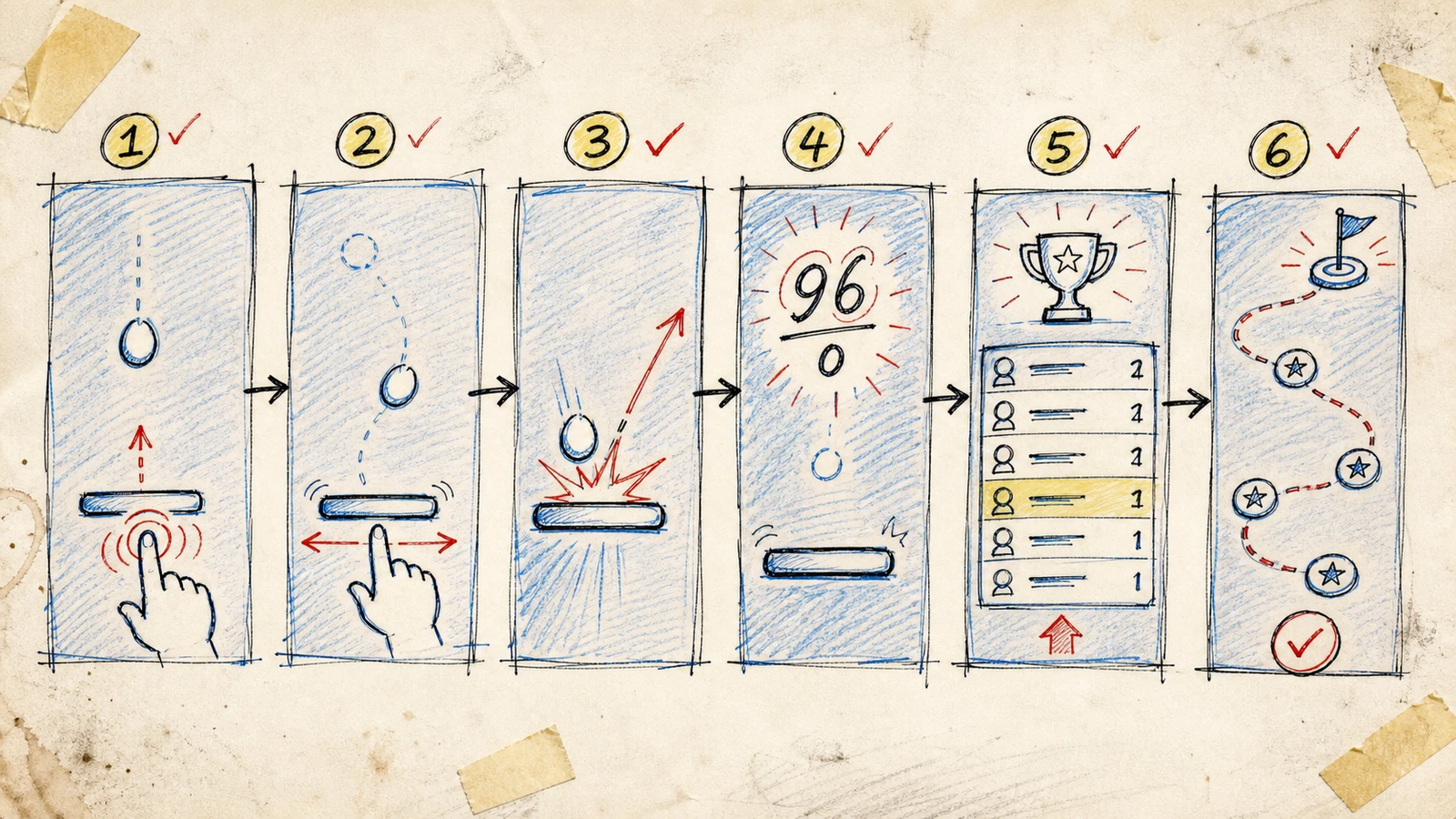
RacketGO is a hyper-casual Android game built with Unity and C#. In one week, the project reached a playable loop, its own identity, a persistent record, achievements, a leaderboard and Google Play Games integration. That feature list can make the delivery sound like a story about speed. The more useful lesson, however, lies in the order in which uncertainty was closed.
The short deadline did not allow every front to grow at once. First, the gesture had to produce a readable response. Then, that response had to sustain repetition. Only after that did it make sense to connect competition, continuity and mobile services to something that already worked.
The week as a product constraint
RacketGO’s proposition can be condensed into three beats: one gesture, one point, one more run. That phrase acts as a scope boundary. Every decision needs to help players perform the gesture, understand its consequence or find a reason to try again.
In a short project, scope is not only a feature count. It is also the distance between an action and its confirmation. The more screens, rules or dependencies sit between touching the racket and seeing the result, the more states need to be implemented, communicated and corrected.
RacketGO shortened that distance. The portrait frame keeps the ball, racket and score on the same axis of attention. The original tutorial reduces its instruction to “HOLD” and two directional arrows; the core action does not depend on a combination of commands. The first product risk, therefore, was not content volume. It was making cause and effect immediately recognizable.
Close the smallest verifiable loop
The core can be described as a short chain: input, contact, trajectory, score and return. Each link resolves a different question:
- input moves the racket responsively;
- contact makes the relationship between gesture and ball clear;
- trajectory lets the player anticipate the next response;
- score records the outcome of the attempt;
- return places the player in front of the same decision again.
If one of those links fails, adding content only expands an unresolved problem. If they all work together, there is already an honest vertical slice: short, but complete enough to be repeated and evaluated.
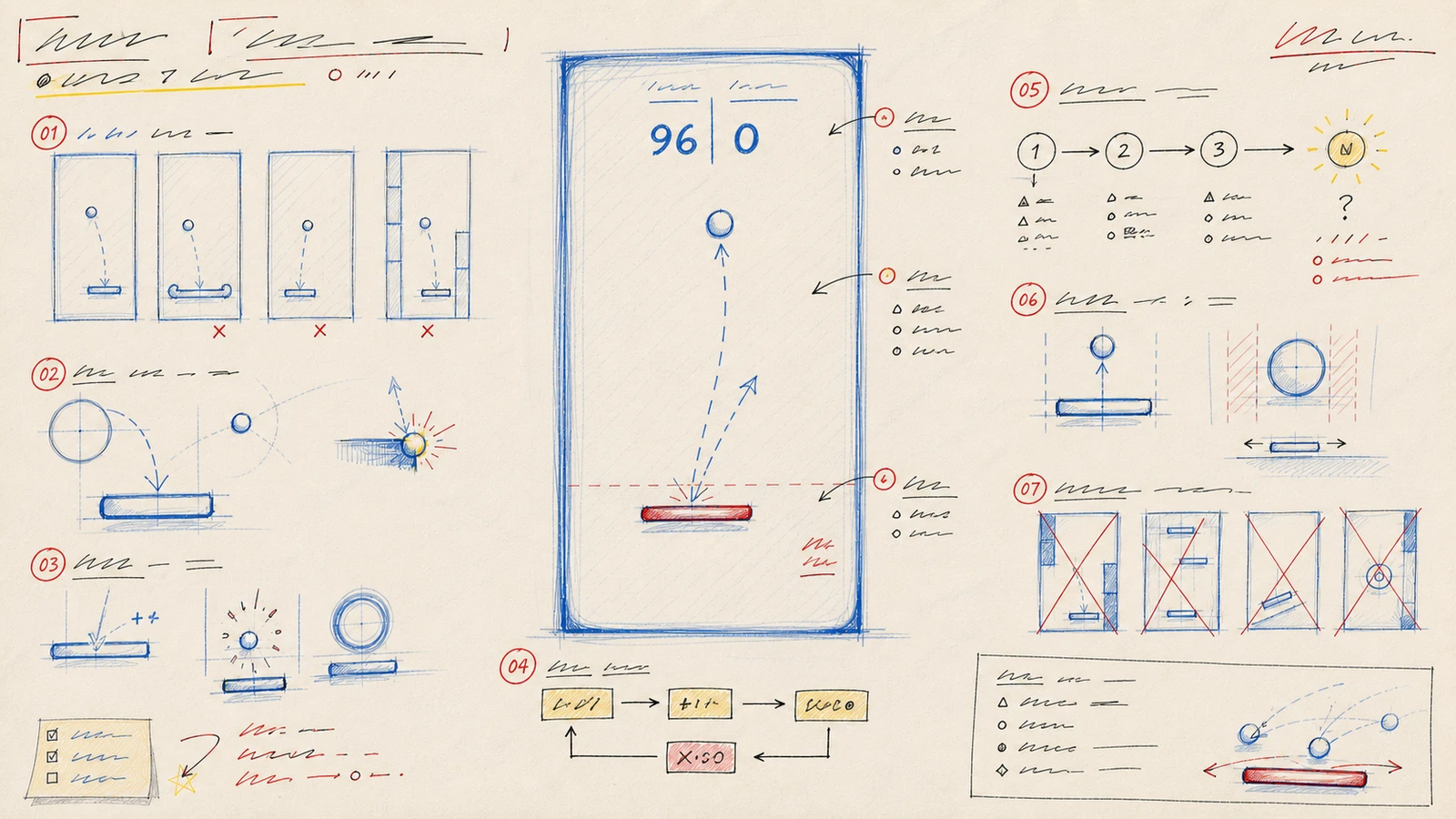
The loop was treated as a verifiable chain, not as a collection of screens.
That distinction matters because “small” and “incomplete” are not synonyms. A prototype can have few elements while still closing entry, action, response, result and restart. That closure makes it possible to learn whether the interaction deserves a product layer.
Make readability survive repetition
The first hit is not enough. In a scoring loop, the composition must remain readable as the ball changes height, the racket moves and the score accumulates results.
The preserved RacketGO frames record the first, fourth, sixth and eighth points. They show the same hierarchy across the sequence: the ball remains distinct against the blue field, the racket occupies a predictable zone and the HUD separates the best score from the current run. In the original footage, that composition supports nine consecutive points and a return to the menu in under 14 seconds. Presentation does not compete with the mechanic; it protects its readability.
Feedback was therefore not decoration added at the end. Contrast, movement and score are part of the test instrument. Before asking whether players want to repeat, the game needs to make what they just did visible.
Metagame only after the gesture
A hyper-casual loop can end as a single disposable attempt. RacketGO added a continuity layer, but each system answers an intention that already emerges from the match:
- the best/current pair turns each run into an attempt to beat a personal record;
- achievements turn loop events into goals, from the first match to new scoring milestones;
- the leaderboard turns score into comparison with other players;
- Google Play Games connects records and achievements to platform services.
This sequence avoids building motivation around an action that cannot yet sustain itself. A leaderboard does not fix a confusing hit. An achievement does not make the trajectory readable. Persistence does not replace feedback. Metagame gains value when it expands a reason to continue that the loop has already created.
The criterion is not “how many systems fit into seven days?” but “which next layer closes a promise that is already visible?”. That question reduces rework because every new dependency enters on top of a state that can be observed.
Read the week through five stages
The preserved artifacts do not contain a precise diary of each production day. Inventing that schedule would create a level of precision the project does not document. The more honest reconstruction uses the five stages as a reading of decisions, not as a rigid calendar. Within one week, they compress, overlap, and return whenever a test demands it:
- Concept: reduce the promise to one gesture, one point and one more run;
- Prototype / Playtest: close the smallest playable loop and repeat it;
- Validation: confirm in play that gesture, trajectory, feedback and score remained readable;
- Polish: refine contrast, identity and mobile presentation;
- Ship: consolidate persistence, competition and platform services into a complete Android delivery.
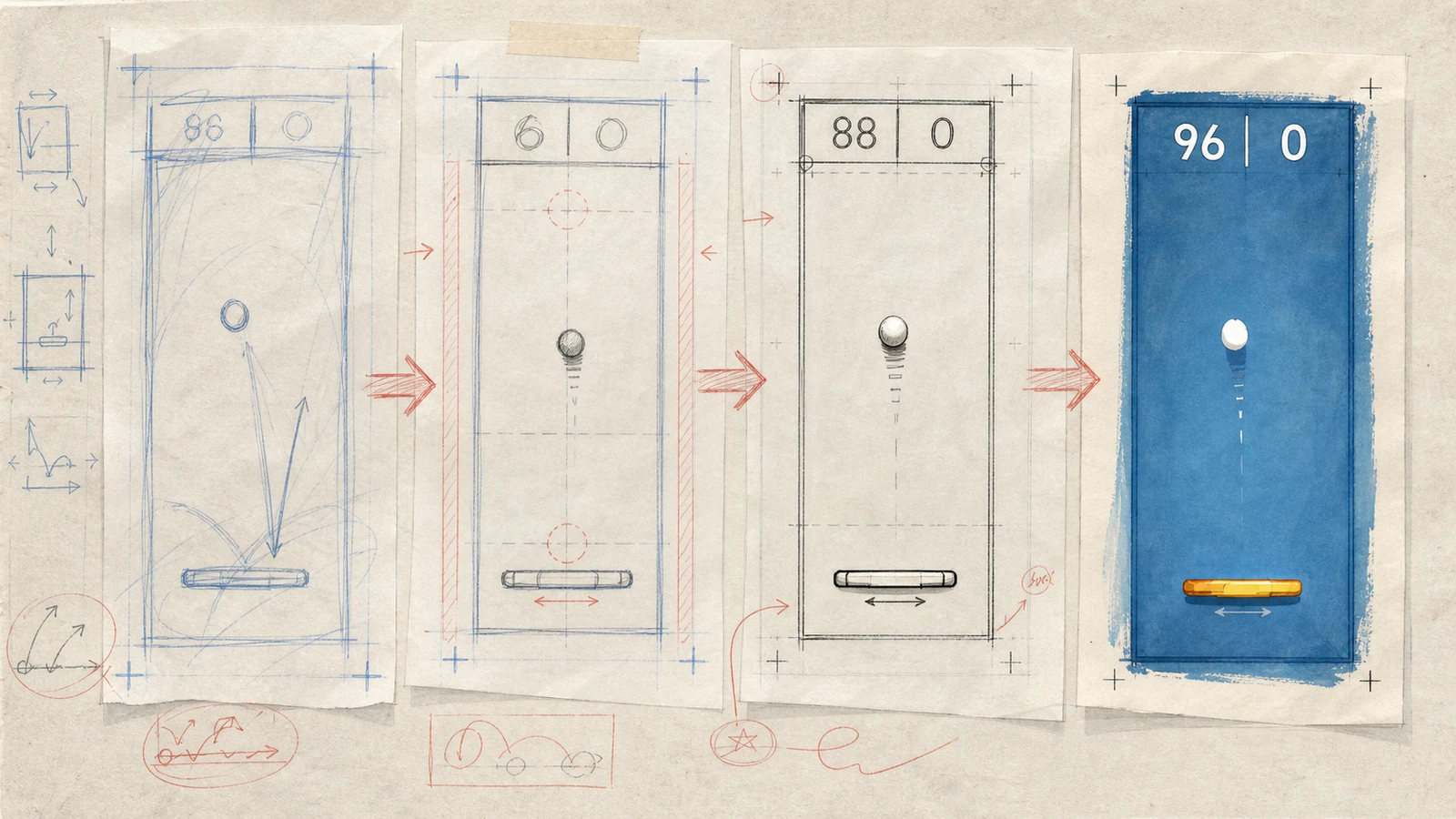
Concept, prototype, validation, polish and ship make the order of decisions visible.
The stages make dependencies explicit. The leaderboard depends on a trustworthy point; progression depends on a persistent result; platform integration depends on states that can be reconciled. They are not a straight line: a test can send production back to the prototype before the build advances again. Working in that order matters more than artificially assigning one feature to each day.
PROCESS 01—05 · See the full path — from idea to release
What one week actually proves
The delivery shows that a mobile slice can move from one gesture to a structured experience within a radically short deadline. It also demonstrates scope discipline: one core interaction, one recognizable portrait frame and continuity systems connected to the same promise.
One week alone does not prove retention, scale, revenue or market validation. Those outcomes would require metrics and live operation that are not part of this case. The evidence here is different: a playable product was closed without confusing completeness with volume.
That boundary makes the case stronger. Speed stops being an abstract claim and becomes observable in the relationship between deadline, scope and the final state of the build.
Speed is a sequencing decision
Before starting a short-deadline mobile prototype, it is worth answering:
- which action needs to be understood without a long explanation;
- which minimum chain turns input into outcome;
- which feedback makes every transition readable;
- which state needs to survive the next attempt;
- which continuity layer gives repetition meaning;
- what can remain clearly outside this delivery.
RacketGO does not teach how to compress any game into seven days. It teaches something more useful: when the deadline is short, every system needs to close the same promise. Speed appears when production reduces uncertainty in the right order—first the gesture, then the point, then one more run.